Nicaragua and China aim for mutual benefits from ambitious airport development collaboration
Nicaragua's Government, in collaboration with China CAMC Engineering, recently commenced construction on an ambitious USD400.49 million project to expand Punta Huete Airport.
The government intends to transform the currently unused (for commercial operations) infrastructure into an international airport fit to serve as a hub for transportation, logistics and international trade.
These ambitions will be supported by the construction of a 3,600m runway, which would dwarf Managua Augusto Cesar Sandino Airport's (MGA) 2,442m length.
Managua Augusto Cesar Sandino Airport is currently the sole international gateway to Nicaragua
Located on the other side of Lake Managua from Punta Huete, MGA is the only airport in the country which handles international operations.
According to CAPA - Centre for Aviation and OAG data for the week commencing 26-Aug-2024 the airport currently handles international services from Fort Lauderdale, Houston and Miami in the USA, plus San Salvador (El Salvador), San Jose (Costa Rica), Panama City (Panama), Mexico City (Mexico) and Guatemala City (Guatemala).
Managua Augusto Cesar Sandino Airport network map for the week commencing 26-Aug-2024
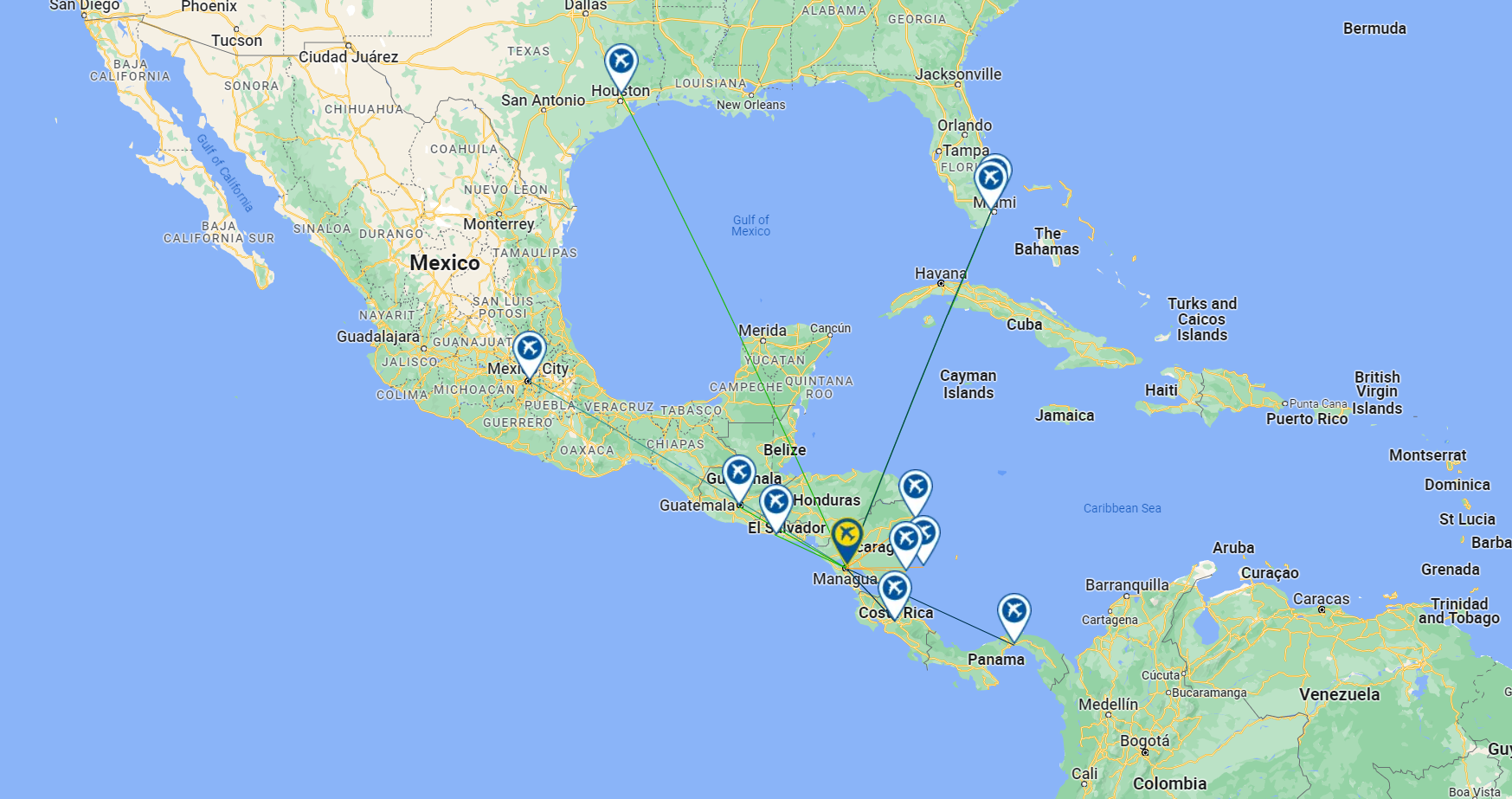
While this network contains many of the usual suspects from the region, it also illustrates the limited range of international connections to the country, with no services from South America or most of North America, let alone the wider world.
This limitation on tourism and trade is no doubt a large motivation for the Punta Huete Airport project, and indeed China CAMC Engineering's involvement in it.
Chinese interests previously involved in projects in Maldives and Nepal
The company is not new to airport expansion projects, having recently signed an MoU to develop Maldives' Kadhdhoo Airport into an international facility, as well as previous involvement in major works at Nepal's Pokhara International Airport.
The Punta Huete Airport project, however, which forms part of China's Belt and Road initiative (BRI), is a venture into geographically unfamiliar territory.
The appeal of involving China from Nicaragua's perspective is obvious. Apart from the fact that the project would be unfeasible without the financing credit agreement between the parties, the government's stated aim of transforming the airport into a hub for worldwide trade can only benefit from Chinese involvement.
From China's side, the project represents an opportunity to add airport development to its growing portfolio of infrastructure projects in Latin America, with 21 countries in the region having signed up to the BRI as of 2023, according to the Council on Foreign Relations.
Punta Huete Airport project set for completion in Aug-2029
Completion of the project is not expected until Aug-2029, at which point the airport will have capacity to handle 3.5 million passengers p/a. This will ease pressure on Managua Augusto Cesar Sandino Airport and expand Nicaragua's international air connectivity, with the focus as much on tourism as on trade.
The "brotherhood between the Sandinista National Liberation Front and the Communist Party of China", as described in the government announcement of the project, is a result of the re-establishment of diplomatic relations between Nicaragua and China in Dec-2021.
The brothers have now linked arms on an ambitious airport project which, if executed successfully, should reap benefits for both parties.