CAPA's Corporate Travel Summit in Singapore hears about crises, LCCs, FFPs and disruption
The corporate market has focussed increasingly on safety and security of travellers in recent years. This is a combination of simple corporate responsibility concerns in the wake of legal liability lawsuits and a real increase in risk of traveling through different regions - or even through previously "safe" areas.
Recent terror attacks have heightened the duty of care focus across the board. It is no surprise that this issue was central at the recent CAPA/ACTE Southeast Asia Corporate Travel Innovation Summit held in Singapore.
This article, written for CAPA by business journalist Allan Leibowitz, highlights some of the views on this topic, on LCC usage by corporates, distribution changes, FFPs and more.
- The corporate market is increasingly focused on safety and security of travelers.
- Recent terror attacks have heightened the duty of care focus in corporate travel.
- Organizational preparedness and a three-phase approach of assess, advise, and assist are important in dealing with increased terror risk.
- Low-cost carriers are gaining popularity in corporate travel, but reliability, safety, and security are still important factors.
- Technology and innovation are shaping the future of corporate travel, with virtual airlines, universal profiles, and travelbots being predicted for 2020.
- The New Distribution Capability (NDC) is being piloted by airlines and has the potential to improve service to corporates and enable additional services.
Corporate travel, in the shadow of terror attacks
There was intense interest in the opening presentation from Grant Strudwick, Regional Security Director, APAC for International SOS/Control Risks.
Mr Strudwick pointed out that while the recent terror attacks in Bamako and Paris and the downing of a Metrojet in Egypt had grabbed headlines, the two most common risk areas faced by travellers are still opportunistic crime and road traffic accidents.
The security expert offered some advice for dealing with the increased incidence of terror, such as avoiding airports with poor security and minimising the time spent in hotel lobbies. Organisations should also take care with hotel selection, floor selection and room security. And, when caught up in an incident, the best approach is to "flee through the nearest exit point, or if not possible, then hide".

Mr Strudwick stressed the importance of organisational preparedness and suggested a three-phase approach of assess, advise and assist. Organisations need to understand the risks and prepare accordingly, know what to do in the case of an event and arrange the necessary on-the-ground support when required, he said.
According to Michael Valkevich, Senior Director, Global Programme Management, Asia Pacific at Carlson Wagonlit Travel and a panellist at the event, duty of care is again a top priority among clients. He explained how CWT staff had rallied in support of their clients during the recent terror attacks, locating travellers and generating reports for travel managers. "The events brought into focus how important it is to book through the corporate channel when the organisation has the duty of care to know where people are," he added.
James Gleeson, Global Head - Non-IT Procurement at Standard Chartered, revealed that his organisation has to balance a very thorough duty of care approach with strong privacy requirements and a "very energetic regulatory community which forces us to take decisions that we wouldn't automatically take".
While the bank escaped the impact of the Paris attacks, it was affected by the Tangiers shootings, with around 600 staff at its outsource site requiring relocation. "We had the earthquake in Nepal which affected us quite badly and we had the bombing in Bangkok, where we unfortunately lost two staff members," he recounted.
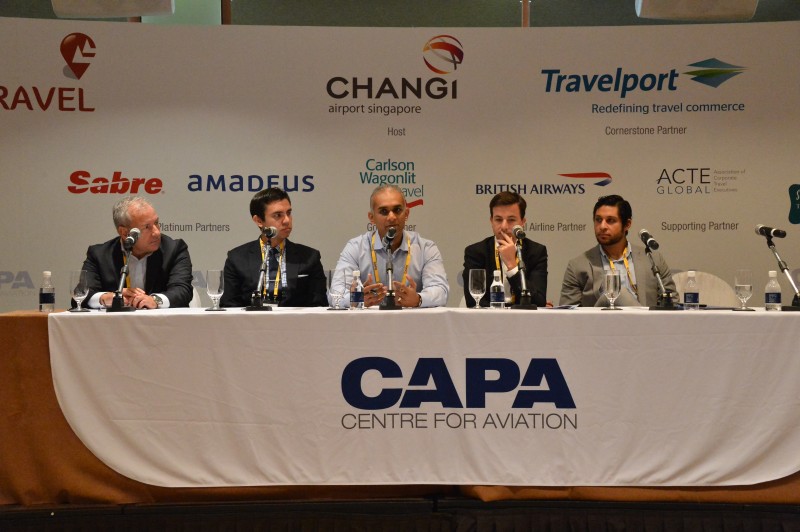
Conrad Clifford, Regional Vice President for Asia Pacific of IATA, conceded that the attack in Egypt was a major concern. "Where we're really looking for improvement is in terms of harmonisation between different states' policies towards security," he commented.
Low cost carriers take off as corporate travel vehicles
Another common theme of the conference was the rise of low cost carriers.
Will Horton, CAPA Senior Analyst - North Asia, set the scene by explaining that low cost carriers accounted for more than half of the intra-regional seats in South East Asia in 2015 - up from 35% in 2008.
In North East Asia, LCC marketshare has quadrupled from single digits in 2008 to around 12% in 2015. Mr Horton also explained how LCCs are adapting to market changes, with some airlines offering more flexibility and ability to change tickets, AirAsia adding premium product and some airlines even providing access to lounges as an add-on.

Asked about addressing customer perceptions of risk among low-cost carriers, Barathan Pasupathi, CEO of Jetstar Asia, said corporates regularly conduct risk audits. Once that box is ticked, he explained, corporate customers look at ease of booking, boarding efficiency, on-time arrivals and the flight experience - all areas in which carriers like his can excel.
CWT's Mr Valkevich agreed that "some LCCs - Jetstar among them - are more ready to be included in corporate programmes than others".
"The LCC sector in this region is a very exciting opportunity and worth a lot of attention," he added.
Mr Gleeson described Standard Chartered's relationships with LCCs as dysfunctional, lamenting losing money with some. "We (now) use them on very specific routes," he said, pointing out that his team is under pressure to meet its travel needs on a tighter budget. They are willing to talk to all suppliers who can provide "safety and security, access to content, a total view of costs and ease of booking".
Travel technology and solutions continue to evolve

Delegates were treated to a glimpse into the future of corporate travel by Johnny Thorsen, Concur Senior Director -Strategy and Product Marketing.
A respected technology evangelist, Mr Thorsen started with three bold predictions for the shape of the travel industry for 2020.
His first prediction is the creation of a "virtual airline".
Just as Uber is providing ground transport services without owning vehicles and Airbnb has become a leading accommodation provider without operating any hotels, Thorsen anticipates that some organisations will start selling seats on other airlines' planes.
"They'll simply consolidate available seats. The technology is there; it's just about industry opening the door to make it happen."
His second prediction, after 25 years of filling out traveller profiles, is a universal profile. He called on the industry as a whole to adopt a QR code approach. Travellers, he said, will only deal with suppliers that recognise that code "and companies will save a fortune by not having to create their own data".
Mr Thorsen's third prediction concerns automated information systems he calls travelbots. "It'll be hard to talk to someone by 2020 unless you put $100 on the table for advice. We're going to get intelligent services that will understand your situation, what your pattern of behaviour is, what you normally do, and they'll be able to give you answers in a microsecond. It's all about using the big data that's sitting under the surface, telling everyone all about me through my universal profile."
The impact of technology was explored further in a panel discussion on disruption.
Todd Arthur, Managing Director - SE APAC of hotel aggregator HRS, spoke about how his company had started as a disruptor but has become an enabler. The challenge, he said, is accommodating the new ways of booking with mobile devices while still meeting organisational needs "to provide data, secure savings and monitor their contracts".
Mr Arthur was also struck by the pace of change in Asia, and the leapfrogging of technology, where self-booking had not previously been possible because people didn't have computers, but they are now embracing their mobiles and happy to use apps.
Amadeus Head of Corporate IT Frederic Saunier described his organisation as unique in its reach in the travel ecosystem, with clients ranging from airlines to airports, TMCs and corporates. As the youngest of the three global GDSs, Amadeus tries to be disruptive through innovation, according to Mr Saunier, citing last year's investment of more than EUR550 million in product development. "And when we can't disrupt, we partner with disrupters," he pointed out, referring to the Amadeus Next programme of investing in travel tech start-ups.
Roshan Mendis, Senior Vice President of Sabre Travel Network, spoke about Sabre's acquisition of the region's biggest GDS, Abacus. "The two big messages (following the acquisition) are 'everything stays the same' and 'everything gets better'," he said, explaining that all customers will benefit from Sabre's global experience and capability.
"We have to live as if we will get disrupted," he said, "and the way we combat that is to innovate at a faster pace, leveraging our resources, our scale and the relationships we have."
He spoke about the need for open platforms which can accommodate the new content. He pointed to TripCase, which now has Uber and Corporate Housing integrated into it. "Those two slivers of the sharing economy are demanded and accepted in corporate travel programmes," he said.
Mr Saunier also recognised the need for traditional booking systems to be open to the sharing economy to facilitate compliance. Amadeus, he said, is going a step further, integrating user feedback into its eTM booking tools.
Mark Rademaker, MD - Emerging Markets for payment solutions provider UATP, is anticipating accelerated disruption in the payment space in the next couple of years. To date, UATP has worked with BitNet, AliPay and PayPal to ease the payment challenges for its airline customers. "It's easier for us to work with (these new channels) than for them (our airline partners)."
Emre Mangir, COO of ground transport aggregator Mozio, explained how his service has added "a piece of the travel chain that has not historically been part of the GDS offering" to corporate buyers.
Mozio, he said, is working with TMCs to help them understand how to harness Uber and its regional equivalents "that are more or less unaccounted for in corporate programmes".
Distribution channels on the brink of change
The Executive Panel spent some time discussing the New Distribution Capability, which IATA's Mr Clifford explained as a new standard to get all travel content through the Internet. "Initially, there was a lot of fear from the GDSs that NDC was going to bypass them. … Where we are today is that we're running a number of pilots with airlines around the world," he said.
At the moment, full service airlines are using it for ancillary revenue, while low cost carriers are plugging straight in.
"We're also working with GDSs - Amadeus in particular - to see how we can use this standard to deliver a better service to corporates."
Richard Edwards, UK-based Director & Managing Consultant of Revidio Limited, sees TMCs as the big beneficiaries of the new standards because they'll be able to sell additional services. "At the moment, TMCs don't like selling EMDs (Electronic Miscellaneous Documents or ancillaries)" because it's an additional transaction that isn't remunerated. "In the future, you're looking at one order and you'll be able to do everything in one transaction - flights, extra legroom, car hire, etc.," he explained.
Mr Valkevich sees a big opportunity for standardisation with the NDC. "Where IATA is making a contribution is by harmonising the process so we don't have a number of disparate things necessitating the standards."
Mr Gleeson said travellers expect content across a variety of platforms and called on suppliers "to make it easy or else the noise will never go away".
Buyers share insights into innovation

The Innovation Summit included presentations from four corporate travel managers in a session facilitated by ACTE's Asian Director, Benson Tang.
John Holden, Executive Director, Corporate Services & Real Estate at Goldman Sachs, shared his views on "the digital traveller".
Mr Holden described the travel environment as having multiple touchpoints across air, accommodation, ground transport and other services.
He flagged opportunities to leverage digital technology to improve efficiency, productivity and convenience.
Mr Holden shared a range of travel apps and platforms used pre-trip, during travel and post-trip, and noted a trend among suppliers "streamlining, integrating and improving the online experience" of their apps and websites. However, he said, they still require manual data input and only cover limited aspects of travel.
"We don't need more apps or more functions. We actually need less apps but more integrated platforms", he said, suggesting that airline alliances use one app for all members, for example.
Mr Holden is seeing a number of organisations building their own apps, but warned that if they don't increase efficiency and produce an ROI, they won't attract investment.
Rio Tinto Global Category Principal Michael Molloy looked at corporate use of LCCs, noting that most travel programmes now include these carriers, but "not as a cornerstone".
To gain acceptance, he said, LCCs need to be easy to buy and accessible via GDS. He also stressed the need for reliability, safety and security.
Steven Yeow, Regional Procurement Lead, Asia Pacific & Greater China of ECOLAB, described the challenges of managing a regional programme that spanned various cultures, languages, political systems and regulatory environments. The task is made even more challenging by the differing priorities which range from cost cutting to duty of care, compliance, efficiency, safety and innovation.
It's vital, he said, for travel managers to understand where their organisations are coming from and where they are headed.
Serene Chua, McDermott Asia Pacific Travel Manager, related her experiences of sourcing TMCs over the past 15 years. She dismissed the sales pitches of the various TMCs, saying "they're all the same".
"I'm looking for something different," she said, explaining that she now looks for TMCs that use one GDS system that is accessible from all locations, that can show seat availability from multiple locations on one screen and that have skilled and experienced travel consultants.
Living with - and against - loyalty programmes
Loyalty programmes have long divided the business travel sector. Buyers love them because they reward the use of services which travellers already favour. Travel managers often have to fight against the lure of traveller points or miles when they need to ensure compliance to suppliers who benefit the organisation rather than the individual traveller.
A panel on this topic heard from Javier Cedillo-Espin, Senior Vice President - Loyalty at Accor, who said programmes these days are designed to improve the traveller experience by enhancing efficiency. "Before it was about points and status; today it's about efficiency and so much more," he said, explaining that benefits include early check-in/late check-out.
Matthew Stewart, Managing Director, Singapore at ATPI, observed that the current challenge is "balancing the ego needs of the travellers with compliance issues". He warned against revenue-based airline reward programmes which "incentivise your travellers to book at the last possible minute, to get the highest possible fare for their journey".
FCm Travel Solutions General Manager Bertrand Saillet pointed out that the basic "three quotes" approach is one way of addressing the threats posed by loyalty programmes, and even more so when most of those quote processes include low-cost carriers. Mr Saillet also called for some flexibility, especially when the difference between an LCC and a full-service airline is small and the traveller's loyalty programme includes lounge access and the benefits associated with that.
For organisations that allow travellers to accumulate and use frequent flier points, two speakers, Affinity Capital Exchange Inc Founder and CEO Atanas Christov and iFLYflat Founder and Chief Executive Steve Hui, discussed some of the strategies for maximising and optimising points. The two organisations are among an emerging segment of loyalty reward intermediaries.
And finally, some words of inspiration: opportunities to make mistakes
Berthold Trenkel, Executive Vice President, Global Traveller Services at Carlson Wagonlit Travel, shared his rules for superior client satisfaction in an entertaining and informative presentation filled with personal experiences.
Mr Trenkel leads a team of 14,000 people and conceded that there were "lots of opportunities to make mistakes". His presentation addressed ways of anticipating and preventing the lapses which affect customers, responding quickly when things do go wrong and recovering customer satisfaction and loyalty.
His aim, he said, was traveller satisfaction because "happy travellers mean happy travel managers". To watch the presentation, click here.
There will be plenty more to come in 2016 …
The Singapore Corporate Travel Innovation Day capped a successful year of CAPA events for the business travel sector in the Asia Pacific region.
Next year, CAPA will build on this experience with its most ambitious programme of corporate travel events ever.
CAPA has joined forces with the Association of Corporate Travel Executives (ACTE) to provide 10 major Corporate Travel Summits in the Asia Pacific region for 2016.
"CAPA and ACTE have been working together on various programmes throughout the world," according to Peter Harbison, Executive Chairman of CAPA.
"Both groups share common objectives and a common vision. ACTE's reputation for innovation and senior level educational programmes is a perfect match for CAPA's services, which span the interests of airline CEOs and business travel managers. "Combining … events provides more options for clients and members, while enhancing opportunities for buyers and suppliers."
Further details of the combined events can be found here.
(Allan Leibowitz is a business journalist who edited Business Travel Monthly/Management for more than a decade and also transformed Procurement Professional into a leading resource in the Australasian market. His business travel reporting career has included several visits to Singapore to interview industry leaders and attend conferences. He now leads 'talking business', a content marketing and events consultancy which specialises in procurement and business-process issues and is a regular contributor to CAPA.)