Russia targets largescale airport infrastructure modernisation to meet tourism development goals
Russia is set to complete infrastructure development projects at 129 airfields, and increase the number of airfields in the country from 228 to 242 by 2030.
The far reaching airport modernisation programme is part of a broader focus on domestic aviation and tourism development.
Construction plans cover a range of infrastructure development projects
Russia's Federal Air Transport Agency (FAVT) has identified 129 airfields to develop in the period to 2030.
The 129 airfield development projects can be broken down as follows:
- Reconstruction and new construction: 76 airfields, including 29 airfields in the Far East Federal District. Development work is planned for one of four purposes:
- Remove operating limitations;
- Upgrade airfields that have not undergone reconstruction in the last 20 years;
- Drive development of air travel with new airfields;
- Construction plans carried over from previous planning period.
- Capital repairs: 53 airfields will undergo capital repairs and will receive new airfield lighting systems. A new fund for the development of air transport infrastructure is being established.
Funding will include EUR1 billion in private investment
In Jun-2024, Russia's Ministry of Transport estimated development of airfield infrastructure from 2025 to 2030 will require a total investment of RUB381 billion (EUR3.87 billion), with RUB265 billion (EUR2.70 billion) to be provided in federal budget funds.
The Transport Ministry also applied for an additional RUB250 billion (EUR2.54 billion) in government funding.
Implementation of projects under public-private partnerships is expected to attract RUB104 billion (EUR1.06 billion) in investment funds.
Domestic travel is the source of traffic growth for Russian carriers
Russian carriers recorded 62.9 million passengers in the seven months ended Jul-2024, an increase of 6.4% year-on-year, with domestic passengers increasing 2.3% to 47.9 million.
Russian carriers handled more than 105 million passengers in 2023, an increase of 10.5% year-on-year.
While domestic passengers increased 13.5% compared to 2019, with carriers recording 83 million passengers, international passengers decreased 60% to 22 million.
Russia is connected to destinations in 36 countries, with the country's international network limited due to sanctions.
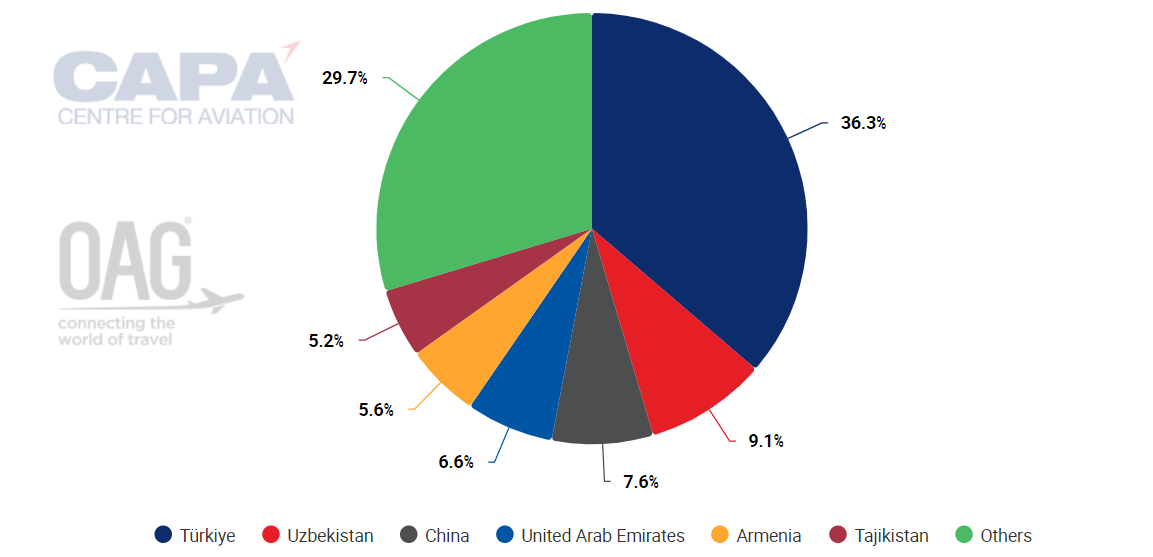
In the week commencing 19-Aug-2024, Russia's key markets by international departing seats are Türkiye (36.3%), Uzbekistan (9.1%), China (7.6%), UAE (6.6%), Armenia (5.6%) and Tajikistan (4.8%).
Russian Federation, largest airports by system seats, week commencing 19-Aug-2024
Construction projects will contribute to domestic tourism development
Russia's airport construction plans include the construction of a new Sheregesh Airport and new Arkhyz Airport. Both airports are located near ski resorts and are targeting tourism growth.
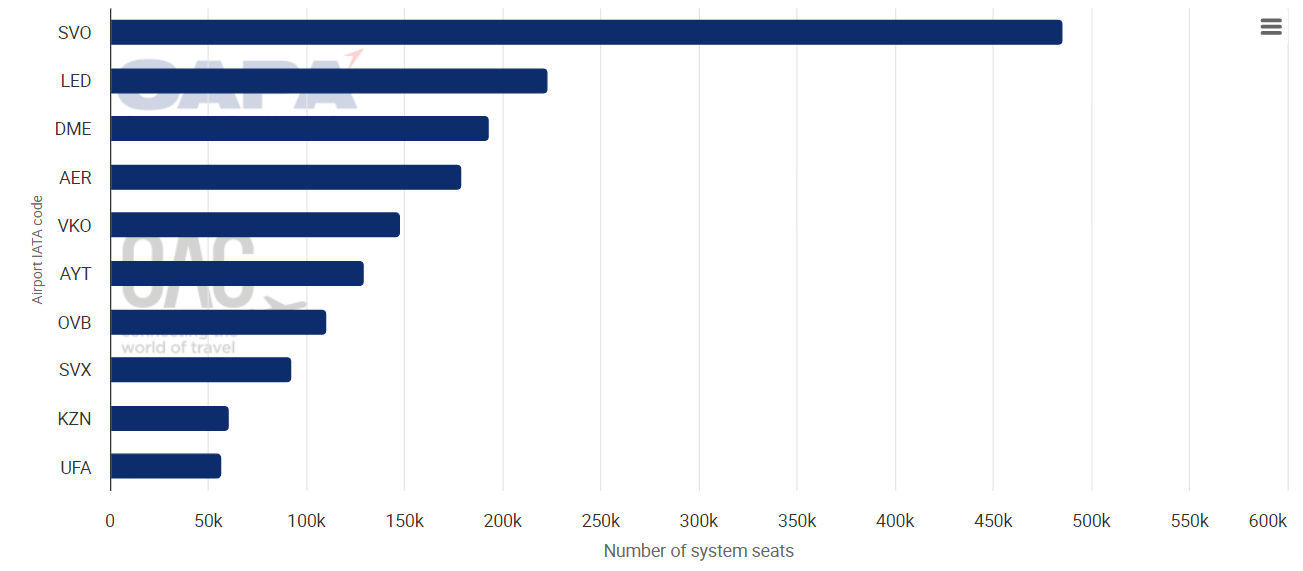
Saint Petersburg Pulkovo Airport is looking to commence a large scale development project in 2025, covering terminal and airfield development.
In the week commencing 19-Aug-2024, the airport is Russia's second largest hub by seats, as well as second in Russia by seats for international arrivals.
Russian Federation, largest airports by system seats, week commencing 19-Aug-2024
Ensuring modern airport infrastructure is a piece of the puzzle in surviving adverse external circumstances
Russia's airport development plans support the objectives set by President Vladmir Putin to increase air travel trips per capita by 50% by 2030, compared to 2023, and improve air travel affordability.
As previously stated by CAPA - Centre for Aviation, in a report entitled: 'Global airport construction and investment report mid-2024 - Part 1 - Intro, Asia Pacific & Europe' (18-Jul-2024) the number of airport construction projects in Russia is likely to increase in line with government statements and the increasing presence and ambitions of private sector operators that are based there. Development of airport infrastructure is a key part of investment into domestic tourism at a time when external opportunities are limited.