High altitude contrails could be the low hanging fruit for greener aviation
Studies suggest contrails could have a greater climate impact than the CO2 emissions from aircraft, so minimising contrails may become a short term priority for improving the sustainability of the airline industry.
Contrail management has the potential to deliver quick environmental performance gains for the industry, alongside medium and long term measures such as sustainable aviation fuel (SAF) and alternative propulsion technologies.
Modern aircraft create more and longer lasting contrails than older aircraft that operate at slightly lower altitudes
A study by researchers from Imperial College London and The Grantham Institute for Climate Change, published in Environmental Research Letters on 07-Aug-2024, found that modern aircraft operating over the North Atlantic create more and longer lasting contrails than older aircraft that operate at slightly lower altitudes. While the more efficient modern aircraft emit less CO2 than older models, their climate impact through contrails could be greater.
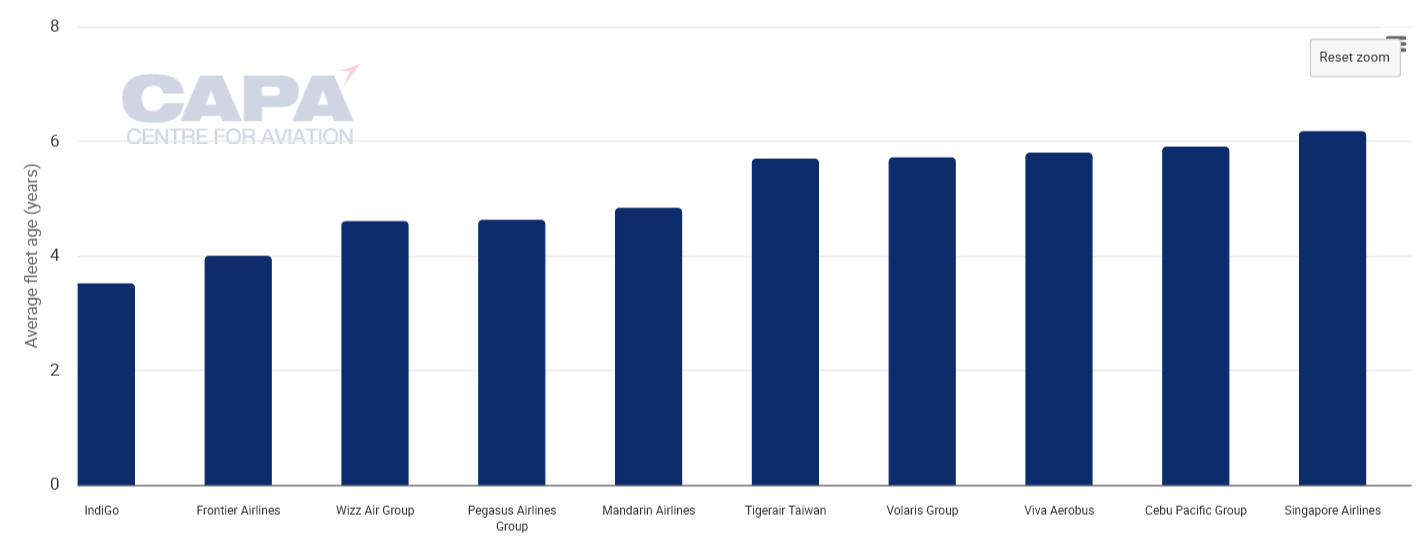
Average fleet age for financial year 2023 (10 youngest)
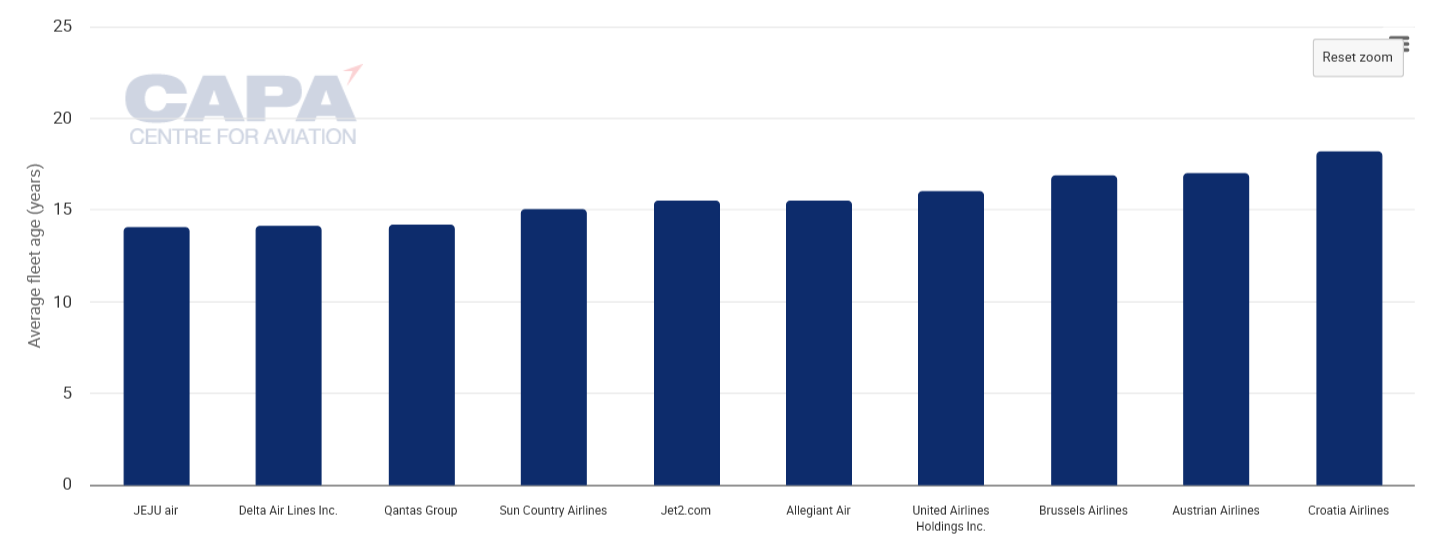
Average fleet age for financial year 2023 (10 oldest)
The study also provides the first evidence that reducing the amount of soot particles emitted from aircraft engines can shorten the lifetime of contrails.
Scientists believe warming effect of contrails is greater than warming caused by carbon emissions from aircraft
Imperial College London noted that scientists believe the warming effect of contrails is greater than the warming caused by carbon emissions from aircraft, although the exact warming effect of contrails remains uncertain.
SATAVIA, a provider of atmospheric data aiming to help prevent contrail formation, has claimed that contrails contribute more than 60% of the aviation industry's climate impact, representing approximately double the impact of direct CO2 emissions from aircraft.
The industry is actively seeking more data and greater funding for research into the non-CO2 climate effects of aviation, including contrails.
In Apr-2024, IATA stated the potential gains from contrail mitigation remain "uncertain" and called for more research.
In the same month, Airlines for America expressed its support for contrail research to reduce scientific uncertainty.
Technology leaders from Airbus, Boeing, Dassault Aviation, GE Aerospace, Rolls-Royce, RTX and Safran issued a call for more funding and government research programmes in Jul-2024.
Research into contrails will help industry better understand their impact
Substantial research into contrails is underway in several locations, including a trial involving airlines in Germany led by Deutsche Flugsicherung, the German Aerospace Centre (DLR) and the Working Group for Climate-Neutral Aviation.
In Apr-2024, SATAVIA announced it had completed contrail management trials on 65 flights involving 12 airlines. American Airlines reported "encouraging" results in Aug-2023 from a "small scale" study on contrail avoidance.
Studies have also found that the use of SAF can have benefits for contrail formation.
In Jun-2024, Airbus, DLR, Neste and Rolls-Royce reported that using 100% SAF in both engines of a commercial aircraft reduced the number of soot particles and the formation of ice crystals, compared to reference Jet A-1 fuel, potentially reducing the warming effect of contrails.
Virgin Atlantic Airways noted similar findings from its pioneering trans-Atlantic flight using 100% SAF, conducted in Nov-2023.
Boeing, NASA and United Airlines are also investigating the impact of SAF use on contrails.
Industry could gain meaningful sustainability gains by preventing or reducing formation of contrails
Preventing or reducing the formation of contrails could be achieved by providing airlines with relevant atmospheric data and giving them more operational control over their flight paths.
If implemented on a large scale, this would potentially deliver meaningful sustainability gains for the industry more rapidly than other measures such as SAF and alternative propulsion technologies.
The use of SAF remains significantly constrained by supply and cost issues, while new technologies such as electric aircraft and hydrogen fuel remain decades away from widespread adoption.
Contrail management could be a quick win for the industry while these other measures mature.
The main barriers to active contrail mitigation remain the lack of data, air navigation limitations and regulatory restrictions. Clearing these hurdles could unlock rapid and substantial climate progress for the aviation industry.